
Ditto Looper Manual: A Comprehensive Guide (Updated 02/03/2026)
Today’s date is 02/03/2026 12:27:04. This manual details the TC Electronic Ditto Looper, a compact and user-friendly looping pedal perfect for beginners and experienced musicians alike;
The TC Electronic Ditto Looper emerged in 2013 as a remarkably simple yet effective tool for musicians seeking an easy-to-use, dedicated looper. Designed with guitarists specifically in mind, it quickly became a superb introduction to the world of looping, fostering both practice and creative exploration. This pedal distinguishes itself through its minimalist approach, offering a plug-and-play experience without unnecessary complexity.
The Ditto Looper’s core philosophy centers around intuitive operation. It’s built to take up minimal space on your pedalboard while still delivering essential features that inspire guitarists. Key among these are True Bypass and Analog-Dry-Through circuitry, ensuring your original tone remains uncolored and pristine. The pedal records loops as uncompressed 24-bit audio, preserving the full dynamic range of your playing. It’s a powerful tool for solo performers, band rehearsals, and studio experimentation.
What’s in the Box?
Upon opening your new TC Electronic Ditto Looper package, you’ll find everything needed to begin creating loops immediately. The box contains one (1) Ditto Looper pedal itself, the heart of your looping experience. To help you get started quickly, a Ditto Looper quick guide is included, providing essential instructions for basic operation and troubleshooting. This guide will walk you through the initial setup and core functionalities of the pedal.
Additionally, the package includes two (2) rubber feet. These feet are designed to be attached to the underside of the pedal, providing a stable and secure grip on various surfaces, preventing slippage during performance or practice. Please note that a 9V external power supply is not included and must be purchased separately to power the Ditto Looper. Ensure you have a compatible power supply before attempting to use the pedal.
Understanding the Pedal Layout
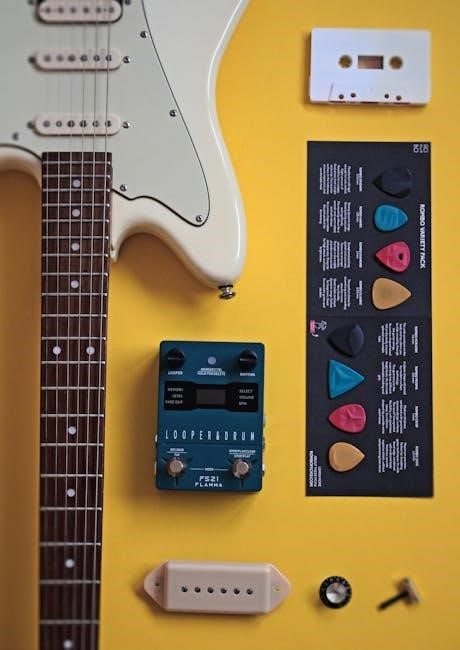
The TC Electronic Ditto Looper boasts an incredibly streamlined and intuitive layout, prioritizing ease of use. The entire front panel features only a single footswitch and one control knob. The footswitch handles all looping functions – pressing it once starts recording, a second press stops recording and begins playback, and a third press overdubbing. A long press will undo/redo the last action.
The single knob controls the loop level, allowing you to adjust the volume of the looped audio. Turning the knob clockwise increases the loop volume, while turning it counter-clockwise decreases it. This simplicity is intentional, designed to get you looping quickly without getting bogged down in complex settings. True Bypass circuitry and Analog-Dry-Through ensure your original signal remains pristine. The pedal’s compact size also contributes to its straightforward design, making it ideal for any pedalboard.
Powering the Ditto Looper
The TC Electronic Ditto Looper requires a standard 9V DC external power supply to operate. Important: A power supply is not included with the pedal. It’s designed to function optimally with a 9V DC center-negative power adapter, commonly used for guitar pedals. Using an incorrect power supply could damage the unit, so ensure compatibility before connecting.
The Ditto Looper does not operate on batteries. A stable and reliable power source is crucial for consistent performance during looping sessions. The power input is a standard 2.1mm DC jack located on the back of the pedal. We recommend using a regulated power supply to minimize noise and ensure clean audio. Avoid using daisy-chain power supplies if possible, as they can sometimes introduce unwanted hum or interference.
Basic Looping Operation
The Ditto Looper’s simplicity is its strength. To begin, connect your instrument and amplifier. Press the footswitch once to start recording your first loop. The pedal will capture audio until you press the footswitch again, initiating playback. The loop will then repeat continuously until you press the footswitch a third time to stop looping.
The single knob controls the loop volume. Turning it clockwise increases the volume, while turning it counter-clockwise decreases it. This straightforward design allows for immediate looping without complex settings. Remember, the Ditto Looper is designed for intuitive use – experiment and discover the creative possibilities! It’s a plug-in-and-play experience, ideal for both practice and performance.
Recording Your First Loop
Before recording, ensure your instrument is connected to the Ditto Looper and your amplifier is powered on with a suitable volume level. Press the footswitch once – a red light indicates recording is active. Play the musical phrase you want to loop. The Ditto Looper captures everything you play during this time.
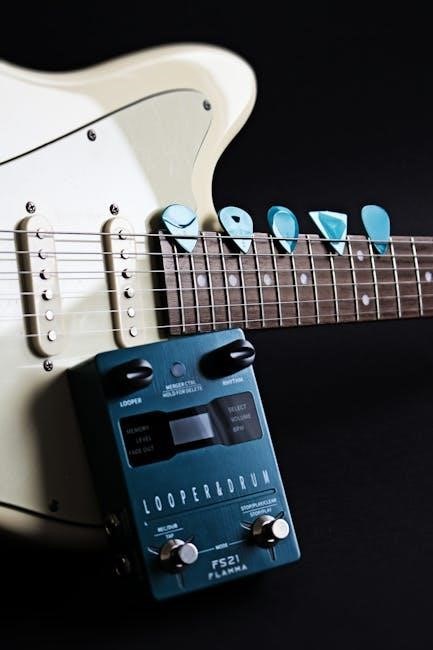
Press the footswitch a second time to finalize the loop and begin playback. The red light will change, signifying the loop is now playing back continuously. The length of your loop is determined by the time between the first and second footswitch presses. Don’t worry about perfection on your first attempt; looping is about experimentation! The pedal records uncompressed 24-bit audio, ensuring high quality.
Overdubbing and Layering
The Ditto Looper truly shines with its overdubbing capabilities. To add layers to your existing loop, simply press the footswitch while the loop is playing. The red light will pulse, indicating you’re in overdub mode. Now, play additional parts on top of the existing loop – these will be recorded and added to the loop’s timeline.
Each overdub adds another layer of sound, building complexity and texture. Press the footswitch again to stop overdubbing and return to loop playback. You can continue overdubbing as many times as desired, limited only by the loop’s memory. Experiment with different sounds and rhythms to create rich and dynamic arrangements. Remember, the Ditto Looper is designed for intuitive creativity!
Adjusting Loop Level
The Ditto Looper features a single, intuitive knob to control the loop level. This knob governs the volume of the looped audio relative to your dry, unprocessed signal. Turning the knob clockwise increases the loop volume, making the loop more prominent in the mix. Conversely, turning it counter-clockwise decreases the loop volume, subtly blending it with your direct signal.
Finding the right loop level is crucial for a balanced sound. Start with the knob centered and gradually adjust it until the loop sits comfortably within your overall mix. Consider the dynamics of your playing and the context of your performance when setting the level. Experimentation is key to achieving the desired sonic blend!
Advanced Features
While remarkably simple, the Ditto Looper boasts several advanced capabilities. Its uncompressed 24-bit audio recording ensures high-fidelity loops, preserving the nuances of your playing. The pedal excels at layering sounds through overdubbing, allowing for complex compositions. It’s designed with guitarists in mind, prioritizing minimal space on your pedalboard without sacrificing essential features.
True Bypass and Analog-Dry-Through are key components, guaranteeing your original tone remains uncolored when the looper is disengaged. Loop storage and management, though not explicitly detailed in basic operation, are inherent to the pedal’s functionality. The Ditto Looper is a powerful tool for both practice and performance, offering a streamlined approach to loop-based music creation.
True Bypass and Analog-Dry-Through Explained
The Ditto Looper incorporates True Bypass circuitry, meaning when the pedal is off, your instrument’s signal passes directly through without any coloration or alteration from the pedal’s internal components. This preserves your core tone, ensuring a pristine sound even when the looper isn’t actively looping.
Complementing this is Analog-Dry-Through. This feature keeps your unprocessed, ‘dry’ signal entirely separate from the loop’s processing path. The dry signal remains purely analog, avoiding any digital conversion that could potentially affect its quality. Together, these technologies guarantee that the Ditto Looper doesn’t compromise your fundamental tone, offering a transparent looping experience. It’s a crucial aspect for tone-conscious musicians.
Uncompressed 24-bit Audio Recording
The Ditto Looper distinguishes itself by recording loops as uncompressed 24-bit audio. This means your loops retain a remarkably high level of fidelity and dynamic range, capturing every nuance of your playing with exceptional clarity. Unlike compressed audio, which sacrifices detail for file size, 24-bit recording preserves the full sonic spectrum of your instrument.
This commitment to high-resolution audio ensures that overdubbing and layering don’t degrade the sound quality. Each layer builds upon the previous one without introducing unwanted artifacts or a loss of definition. The result is rich, full-bodied loops that sound professional and inspiring. It’s a key feature for musicians seeking pristine loop quality.
Loop Storage and Management
The Ditto Looper doesn’t feature traditional loop storage like saving to presets or SD cards. Instead, it operates with a single, persistent loop memory. This means the last loop you created is always the one that’s loaded when you power on the pedal. While seemingly simple, this design prioritizes immediate accessibility and ease of use.
To effectively manage your loops, consider recording directly into your DAW (Digital Audio Workstation) for long-term storage and editing. The Ditto Looper functions seamlessly as an audio interface when connected to your computer. This allows you to capture your creations and integrate them into larger musical projects. Remember to back up your loops regularly to avoid any potential data loss.
Troubleshooting Common Issues
If your Ditto Looper isn’t responding, first verify the power supply is securely connected and functioning correctly. A common issue is using an insufficient power adapter; ensure it provides 9V DC. If the loop sounds distorted or glitchy, try adjusting the input level on your guitar or the loop level knob on the Ditto. Excessive input signal can cause clipping.
Should you experience unexpected behavior, a factory reset can often resolve the problem. (See section ‘Factory Resetting the Ditto Looper’ for instructions). If the pedal still malfunctions, check the connectivity of your cables. Finally, ensure the pedal is placed on a stable surface to prevent accidental footswitch activations.

Addressing Audio Quality Problems
Poor audio quality with the Ditto Looper often stems from input signal issues. Ensure your guitar’s volume is appropriately set – too high can cause clipping, resulting in distortion. The Ditto Looper records in uncompressed 24-bit audio, so the source signal quality is crucial. Experiment with the loop level knob to find the optimal balance between volume and clarity.
If you notice noise, verify your cables are shielded and in good condition. The analog-dry-through feature preserves your original signal, but a faulty cable can introduce unwanted hum. Also, confirm your amplifier settings aren’t contributing to the problem. Finally, remember the Ditto Looper is sensitive to extreme volume fluctuations.

Dealing with Power Supply Issues
The TC Electronic Ditto Looper requires a 9V external power supply (not included). A common issue is using an inadequate power supply – ensure it provides sufficient current (at least 100mA is recommended) and is properly regulated. An unstable power supply can cause erratic behavior, looping glitches, or even prevent the pedal from turning on.
If the pedal isn’t receiving power, double-check the DC jack connection on both the pedal and the power supply. Try a different 9V DC cable to rule out a faulty cable. Avoid using batteries, as the Ditto Looper is designed for external power. If problems persist, test the power supply with another compatible pedal to confirm its functionality.
Factory Resetting the Ditto Looper
Occasionally, the Ditto Looper may experience unexpected behavior requiring a factory reset. This process erases all saved loops and restores the pedal to its original default settings. To initiate a factory reset, ensure the Ditto Looper is powered on.
Press and hold the footswitch while simultaneously connecting the power supply. Continue holding the footswitch for approximately 5-10 seconds until the loop indicator LED begins to blink rapidly. Release the footswitch. The pedal will then reboot with its factory default settings. Note that this action is irreversible, and all custom loops will be lost. A factory reset can resolve persistent glitches or restore functionality after software anomalies.
Ditto Looper Specifications
The TC Electronic DITTO LOOPER is categorized as an effects pedal designed for musicians seeking a streamlined looping experience. It’s a compact unit built for both stage and practice use. Key features include true bypass circuitry, ensuring your signal remains pristine when the looper is disengaged, and an analog-dry-through signal path, preserving the integrity of your unprocessed tone.
Loops are recorded in uncompressed 24-bit audio, delivering high-fidelity sound quality. The pedal operates on a 9V external power supply (not included). It boasts a simple interface with a single loop level knob and a single footswitch for intuitive control. The Ditto Looper is ideal for guitarists and bassists looking for a no-fuss, reliable looping solution.
Dimensions and Weight
The TC Electronic Ditto Looper is designed with portability and pedalboard space in mind. Its compact form factor makes it an excellent choice for musicians who need a looper that won’t dominate their setup. Precise dimensions are crucial for ensuring compatibility with your existing gear and pedalboard layout.
While specific measurements weren’t explicitly detailed in the provided text, the Ditto Looper is consistently described as “compact.” This suggests a relatively small footprint, easily fitting onto crowded pedalboards. The lightweight construction further enhances its portability, making it ideal for gigging musicians. The pedal’s minimal size doesn’t compromise its functionality or build quality, offering a robust and reliable looping solution.
Power Requirements Detailed

The TC Electronic Ditto Looper requires a 9V external power supply to operate, which is a standard power source for most guitar effects pedals. Importantly, a power supply is not included with the pedal itself, meaning you’ll need to purchase one separately if you don’t already have a compatible supply.
Using the correct power supply is crucial for optimal performance and to avoid potential damage to the pedal. While the Ditto Looper doesn’t specify amperage requirements in the provided information, a standard 9V DC power supply with at least 100mA is generally recommended. Ensure the power supply has a center-negative polarity, as this is the standard for TC Electronic pedals. Using an incorrect power supply could void the warranty or cause malfunction.

Connectivity Options
The TC Electronic Ditto Looper features straightforward input and output connectivity designed for seamless integration into your existing guitar or bass setup. It has a standard ¼ inch input jack for connecting your instrument and a ¼ inch output jack for connecting to your amplifier or the next pedal in your signal chain.
A key feature is its analog-dry-through signal path. This means your unprocessed, dry signal passes directly through the pedal, even when a loop is active, preserving your original tone. This is achieved without any digital conversion, maintaining signal integrity. The Ditto Looper doesn’t offer MIDI connectivity or USB for loop transfer; its design prioritizes simplicity and direct, immediate looping functionality. It’s built for quick setup and intuitive operation.