
Algebra 1 McGraw-Hill Textbook PDF: A Comprehensive Overview
This textbook, published by McGraw-Hill, provides a foundational understanding of algebraic concepts. The study notebook, available as a PDF, covers essential topics from variables to equations.
It’s designed for student success!
The ISBN is 978-0-07-890844-6 and MHID is 0-07-890844-2. It was printed in the United States and includes features to aid learning and test preparation.
The McGraw-Hill Algebra 1 textbook serves as a core resource for students beginning their journey into the world of algebraic thinking. This comprehensive text is meticulously designed to build a strong foundation in essential mathematical concepts, progressing logically from basic principles to more complex problem-solving techniques.
The textbook’s structure emphasizes clarity and accessibility, making it suitable for diverse learning styles. It systematically introduces key ideas, including variables, expressions, equations, and functions, providing ample opportunities for practice and reinforcement. The accompanying study notebook, available in PDF format, further enhances the learning experience with targeted exercises and review materials.
Published by Glencoe/McGraw-Hill, the textbook adheres to rigorous academic standards and is intended to prepare students for success in subsequent mathematics courses. Its content is aligned with common core standards, ensuring relevance and applicability in a variety of educational settings. The textbook’s ISBN is 978-0-07-890844-6 and MHID is 0-07-890844-2.
Availability of the PDF Version
The Algebra 1 McGraw-Hill textbook’s study notebook is readily accessible in a convenient PDF format. This digital version offers students a flexible and portable learning resource, allowing access on various devices – laptops, tablets, and smartphones – without the need for the physical textbook.
The PDF can be found and downloaded from the Glencoe website, specifically at this link; This online availability ensures students can easily supplement their learning, review concepts, and complete assignments anytime, anywhere.
The PDF version mirrors the content of the printed study notebook, including “Before You Read” sections, “Key Points” summaries, and “Tie It Together” activities. It’s a valuable tool for reinforcing classroom instruction and preparing for assessments. The document’s copyright is held by The McGraw-Hill Companies, Inc., with all rights reserved, as stated within the PDF itself.
Copyright Information and Usage Rights

The Algebra 1 McGraw-Hill textbook study notebook, including its PDF version, is protected by copyright law. Copyright © by The McGraw-Hill Companies, Inc. grants specific usage rights while reserving all other rights. Reproduction or distribution of any part of this publication, in any form, is prohibited without prior written permission from the publisher.
This restriction extends to storing the material in a database or retrieval system. Any unauthorized use constitutes a violation of the United States Copyright Act. Inquiries regarding permissions should be directed to Glencoe/McGraw-Hill at 8787 Orion Place, Columbus, OH 43240.
The PDF version, available for download, is intended for individual student use as a supplementary learning tool. Sharing the PDF file with others or posting it online is a breach of copyright. The ISBN is 978-0-07-890844-6 and MHID: 0-07-890844-2, identifying the copyrighted work. Respecting these rights ensures continued access to quality educational resources.

Core Concepts Covered in the Textbook
The McGraw-Hill Algebra 1 textbook systematically covers foundational algebraic principles, starting with variables and expressions, progressing through equations, and culminating in functions and logical reasoning.

Chapter 1: Foundations of Algebra
Chapter 1 of the McGraw-Hill Algebra 1 textbook establishes the core building blocks for success in algebra. It begins with 1-1 Variables and Expressions, introducing the fundamental concept of representing unknowns with variables. Following this, 1-2 Order of Operations reinforces the crucial skill of evaluating expressions correctly using PEMDAS.
The chapter then delves into 1-3 Properties of Numbers, exploring essential properties like commutative, associative, and identity. 1-4 The Distributive Property demonstrates a powerful technique for simplifying expressions. Students then tackle 1-5 Equations, learning to represent relationships and solve for unknown values.
Further exploration includes 1-6 Relations, introducing the concept of pairing inputs with outputs, and 1-7 Functions, building upon relations to define a specific type of relationship. Finally, 1-8 Logical Reasoning and Counterexamples develops critical thinking skills, challenging students to analyze and disprove statements. This chapter concludes with a “Tie It Together” activity and “Before the Test” preparation, solidifying understanding.
1-1 Variables and Expressions
Section 1-1 of the McGraw-Hill Algebra 1 textbook introduces the foundational concept of variables – symbols representing unknown values. Students learn how to translate real-world scenarios into mathematical expressions, utilizing variables and operations. This section emphasizes the importance of understanding the difference between a variable, a constant, and a coefficient.
The textbook guides learners through writing expressions from word phrases and evaluating expressions by substituting given values for variables. It stresses the correct application of mathematical operations – addition, subtraction, multiplication, and division – within these expressions.
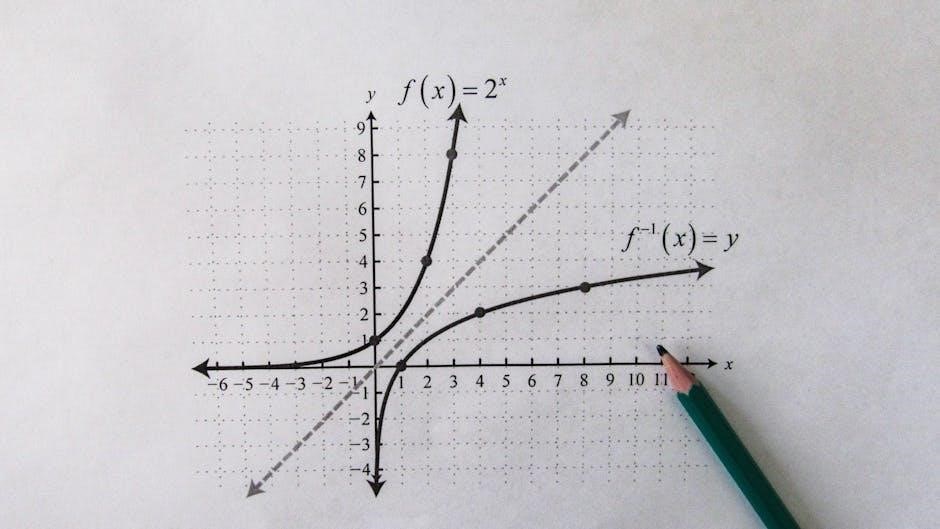
Examples provided illustrate how to represent quantities with variables like ‘x’ or ‘y’, and how to simplify expressions by combining like terms. Mastering this section is crucial as it forms the basis for solving equations and inequalities later in the course. The content begins on page 3 of the study notebook.
1-2 Order of Operations
Section 1-2 of the McGraw-Hill Algebra 1 textbook focuses on the crucial skill of evaluating expressions using the correct order of operations. This is often remembered by the acronym PEMDAS – Parentheses, Exponents, Multiplication and Division (from left to right), Addition and Subtraction (from left to right).

The textbook meticulously explains why following a specific order is essential to achieve a consistent and accurate result. Students learn to simplify expressions containing multiple operations by systematically applying PEMDAS. Numerous examples demonstrate how to correctly evaluate expressions with varying complexities.
Emphasis is placed on avoiding common errors, such as performing addition before multiplication. The section reinforces the concept that mathematical language has specific rules, and adherence to these rules is paramount. This foundational skill is vital for success in all subsequent algebraic concepts, starting on page 5 of the study notebook.
1-3 Properties of Numbers
Chapter 1, section 3 of the McGraw-Hill Algebra 1 textbook delves into the fundamental properties of numbers that govern how we manipulate and simplify mathematical expressions. These properties – Commutative, Associative, Identity, Inverse, and Zero – are the building blocks of algebraic reasoning.
The textbook clearly defines each property with illustrative examples, demonstrating how they allow us to rewrite expressions without changing their value. Students learn how the Commutative Property allows changing the order of addition or multiplication, while the Associative Property concerns grouping.
Understanding these properties isn’t just about memorization; it’s about developing a deeper understanding of the structure of mathematics. This section, starting on page 7 of the study notebook, equips students with the tools to confidently simplify expressions and solve equations, forming a crucial foundation for future algebraic work.
1-4 The Distributive Property
Section 1-4 of the McGraw-Hill Algebra 1 textbook focuses on the Distributive Property, a critical skill for simplifying expressions and solving equations. This property allows us to multiply a term by each term inside parentheses, effectively “distributing” the multiplication.
The textbook provides clear explanations and numerous examples illustrating how to apply the Distributive Property, both with numbers and variables. Students learn to expand expressions like a(b + c) into ab + ac, and how to handle negative signs within the parentheses.
Starting on page 9 of the study notebook, this section emphasizes the importance of careful sign handling to avoid errors. Mastering the Distributive Property is essential for simplifying complex expressions and lays the groundwork for more advanced algebraic manipulations. It’s a cornerstone concept for success in Algebra 1.
1-5 Equations
Chapter 1, section 1-5 of the McGraw-Hill Algebra 1 textbook introduces the fundamental concept of equations. An equation is presented as a mathematical statement asserting the equality of two expressions. The textbook emphasizes that the equals sign (=) is central to understanding equations.
Students learn to identify the different parts of an equation – the variables, coefficients, and constants. The section, beginning on page 11 of the study notebook, details how to determine if a given value is a solution to an equation by substituting it for the variable and evaluating both sides.
The core idea is maintaining balance: whatever operation is performed on one side of the equation must also be performed on the other to preserve the equality. This section builds a crucial foundation for solving equations in subsequent chapters, preparing students for more complex algebraic problems.
1-6 Relations
Section 1-6 of the McGraw-Hill Algebra 1 textbook, starting on page 13 of the study notebook, introduces the concept of relations. A relation is defined as a set of ordered pairs, demonstrating a connection between two sets of data.
The textbook explains how to represent relations using various methods, including tables, graphs, and mapping diagrams. Students learn to identify the domain (the set of first elements) and the range (the set of second elements) within a relation.
This section lays the groundwork for understanding functions, a more specialized type of relation. The material emphasizes recognizing patterns and connections between input and output values. It’s a stepping stone towards grasping the more complex concepts of dependent and independent variables, crucial for future algebraic studies.
1-7 Functions

Building upon the foundation of relations, Section 1-7, beginning on page 15 of the McGraw-Hill Algebra 1 study notebook, delves into the specific type of relation known as a function. A function is defined as a relation where each input (x-value) corresponds to exactly one output (y-value).
The textbook details methods for determining if a relation is a function, including the vertical line test applied to graphs. Students learn to differentiate between functions and non-functions by analyzing tables, mapping diagrams, and equations.
Understanding function notation, such as f(x), is a key component of this section. This notation provides a concise way to represent the output of a function for a given input. This concept is vital for more advanced algebraic manipulations and applications.
1-8 Logical Reasoning and Counterexamples
Section 1-8, starting on page 17 of the McGraw-Hill Algebra 1 study notebook, introduces the crucial skill of logical reasoning in mathematical contexts. This section emphasizes the importance of forming conjectures – educated guesses based on patterns – and then testing their validity.
A core concept explored is the use of counterexamples. Students learn that a single counterexample is sufficient to disprove a general statement or conjecture. The textbook provides examples demonstrating how to identify and construct effective counterexamples.
This section isn’t just about proving things wrong; it’s about developing critical thinking skills. Students are encouraged to analyze mathematical claims, identify potential flaws, and justify their reasoning with clear and concise explanations. This builds a strong foundation for future mathematical proofs and problem-solving.

Chapter 2: Equations and Inequalities
Chapter 2 of the McGraw-Hill Algebra 1 textbook, as detailed in the study notebook PDF, delves into the fundamental concepts of equations and inequalities. Beginning on page 21, this chapter builds upon the foundational algebraic principles introduced previously.
Students will learn to translate word problems into algebraic equations (2-1), and then master the techniques for solving equations. This includes one-step equations (2-2), multi-step equations (2-3), and those with variables on both sides (2-4).
The chapter progresses systematically, equipping students with the skills to manipulate equations and isolate variables effectively. The “Key Points” summaries (page 22) offer concise reviews of essential concepts. “Tie It Together” activities and “Before the Test” preparation sections reinforce learning and prepare students for assessments.
2-1 Writing Equations
Section 2-1, “Writing Equations,” found on page 23 of the McGraw-Hill Algebra 1 Study Notebook PDF, focuses on a crucial skill: translating real-world scenarios into mathematical equations. This section bridges the gap between verbal descriptions and algebraic representation.
Students learn to identify key phrases and keywords that signal specific mathematical operations. For example, “sum” indicates addition, while “difference” suggests subtraction. The goal is to accurately represent given information using variables and mathematical symbols.
This foundational skill is essential for solving word problems and applying algebraic concepts to practical situations. Mastering equation writing allows students to model relationships and solve for unknown quantities. The chapter builds upon previous knowledge of variables and expressions, preparing students for more complex equation-solving techniques.
2-2 Solving One-Step Equations
Chapter 2, section 2-2, “Solving One-Step Equations,” starting on page 25 of the McGraw-Hill Algebra 1 Study Notebook PDF, introduces the fundamental process of isolating a variable. This section builds directly upon the ability to write equations, enabling students to find unknown values.
The core concept revolves around applying inverse operations to both sides of an equation to maintain balance. Students learn to use addition, subtraction, multiplication, and division to undo operations performed on the variable. Emphasis is placed on understanding the equality principle – whatever is done to one side must be done to the other.
Through guided examples and practice problems, students develop proficiency in solving simple equations, forming a solid base for tackling more complex algebraic problems later in the course. This section is vital for building confidence and establishing a strong foundation in algebraic manipulation.
2-3 Solving Multi-Step Equations
Section 2-3, “Solving Multi-Step Equations,” commencing on page 27 of the McGraw-Hill Algebra 1 Study Notebook PDF, expands upon one-step equation solving by introducing equations requiring multiple operations. This builds directly from the previous section, demanding a strategic approach to isolate the variable.
Students learn to apply the order of operations in reverse – undoing addition/subtraction before multiplication/division – to systematically simplify the equation. Combining like terms is also a key skill emphasized within this section, streamlining the equation before applying inverse operations.
The textbook provides numerous examples demonstrating the step-by-step process, reinforcing the importance of maintaining balance throughout. Mastery of this section is crucial for tackling more advanced algebraic problems, as it establishes a robust understanding of equation manipulation and logical reasoning.
2-4 Solving Equations with the Variable on Each Side
Chapter 2, section 4, beginning on page 29 of the McGraw-Hill Algebra 1 Study Notebook PDF, tackles equations where the variable appears on both sides of the equal sign. This represents a step up in complexity, requiring students to strategically manipulate the equation to isolate the variable.
The core concept involves using inverse operations to move all variable terms to one side and constant terms to the other. This process effectively simplifies the equation, allowing for a straightforward solution. The textbook emphasizes maintaining balance throughout, ensuring that any operation performed on one side is also applied to the other.
Numerous examples illustrate this technique, building student confidence in handling these types of equations. This skill is foundational for future algebraic concepts, enabling students to solve more complex problems involving variable expressions on both sides of an equation.

Study Aids and Resources
The McGraw-Hill Algebra 1 textbook PDF includes helpful study aids like “Before You Read” sections, “Key Points” summaries, and “Tie It Together” activities.
“Before the Test” preparation is also included.
Study Notebook Features
The accompanying Study Notebook for the Algebra 1 McGraw-Hill textbook is a valuable resource designed to reinforce learning and improve comprehension. It’s structured to directly correlate with the textbook’s content, offering a space for students to actively engage with the material. Key features include dedicated sections labeled “Before You Read,” which prime students for upcoming lessons by activating prior knowledge and setting learning objectives.
Following each lesson, “Key Points” summaries concisely recap the most important concepts, providing a quick reference for review. “Tie It Together” activities encourage students to synthesize information and apply their understanding to real-world scenarios. Furthermore, the notebook culminates in “Before the Test” preparation sections, offering targeted practice and review to build confidence and ensure readiness for assessments. The copyright is held by The McGraw-Hill Companies, Inc., and all rights are reserved.
“Before You Read” Sections
The “Before You Read” sections within the Algebra 1 McGraw-Hill Study Notebook are strategically placed at the beginning of each chapter and lesson to actively prepare students for new material. These sections aren’t simply introductions; they’re designed to connect upcoming concepts to previously learned knowledge, fostering a more cohesive understanding of algebra. They serve as a crucial bridge, helping students recall relevant prerequisites and anticipate the challenges ahead.
These sections typically include brief overviews, key vocabulary terms, and thought-provoking questions that encourage students to consider the topic before diving into detailed explanations. By activating prior learning and stimulating curiosity, the “Before You Read” sections enhance engagement and improve retention. They are found on pages 1 and 21 of the study notebook, setting the stage for successful learning.
“Key Points” Summaries
The Algebra 1 McGraw-Hill Study Notebook incorporates “Key Points” summaries as a vital component of its learning support system. These concise summaries are strategically positioned to reinforce the core concepts presented within each lesson and chapter, offering students a quick and effective review tool. They distill complex information into easily digestible bullet points, highlighting the most important definitions, formulas, and problem-solving strategies.
These summaries aren’t intended to replace thorough study, but rather to serve as a valuable aid for solidifying understanding and preparing for assessments. Students can use them to quickly refresh their memory, identify areas where further review is needed, and build confidence in their algebraic skills. “Key Points” sections appear on pages 2 and 22, providing essential takeaways.

“Tie It Together” Activities
The McGraw-Hill Algebra 1 Study Notebook features “Tie It Together” activities designed to promote a deeper understanding of the interconnectedness of algebraic concepts. These activities move beyond rote memorization, encouraging students to apply their knowledge in integrated and practical ways. They bridge the gap between individual lessons and demonstrate how different skills build upon one another.
These exercises often present real-world scenarios or complex problems that require students to synthesize information from multiple sections of the chapter. By engaging with “Tie It Together” activities, students develop critical thinking skills and a more holistic grasp of algebra. This section, found on page 19, reinforces learning and prepares students for more advanced mathematical challenges. It’s a key element in mastering the subject.
“Before the Test” Preparation
The McGraw-Hill Algebra 1 Study Notebook provides dedicated “Before the Test” preparation sections to bolster student confidence and readiness. These resources, appearing on pages 20 and later, are strategically placed to facilitate effective review and self-assessment prior to evaluations. They aren’t simply practice problems, but a curated collection of key concepts and representative exercises.
These sections typically include focused practice questions, quick reviews of essential formulas and definitions, and strategies for tackling common test-taking challenges. Students can utilize these tools to identify areas where they need further study and refine their problem-solving techniques. The goal is to minimize test anxiety and maximize performance, ensuring students demonstrate their true understanding of the material.